

Rethinking the world of work – part 2

20. April 2026

Ein Paar auf einer Hängebrücke

Anyone in a leadership role who wants to help shape the future must let go of rigid ways of thinking. According to Sabine Reithofer-Reinhardt, the most important guideposts are mentors, emotion and intuition. The key message is clear: change begins within each of us.

Part 2: Change management requires a paradigm shift

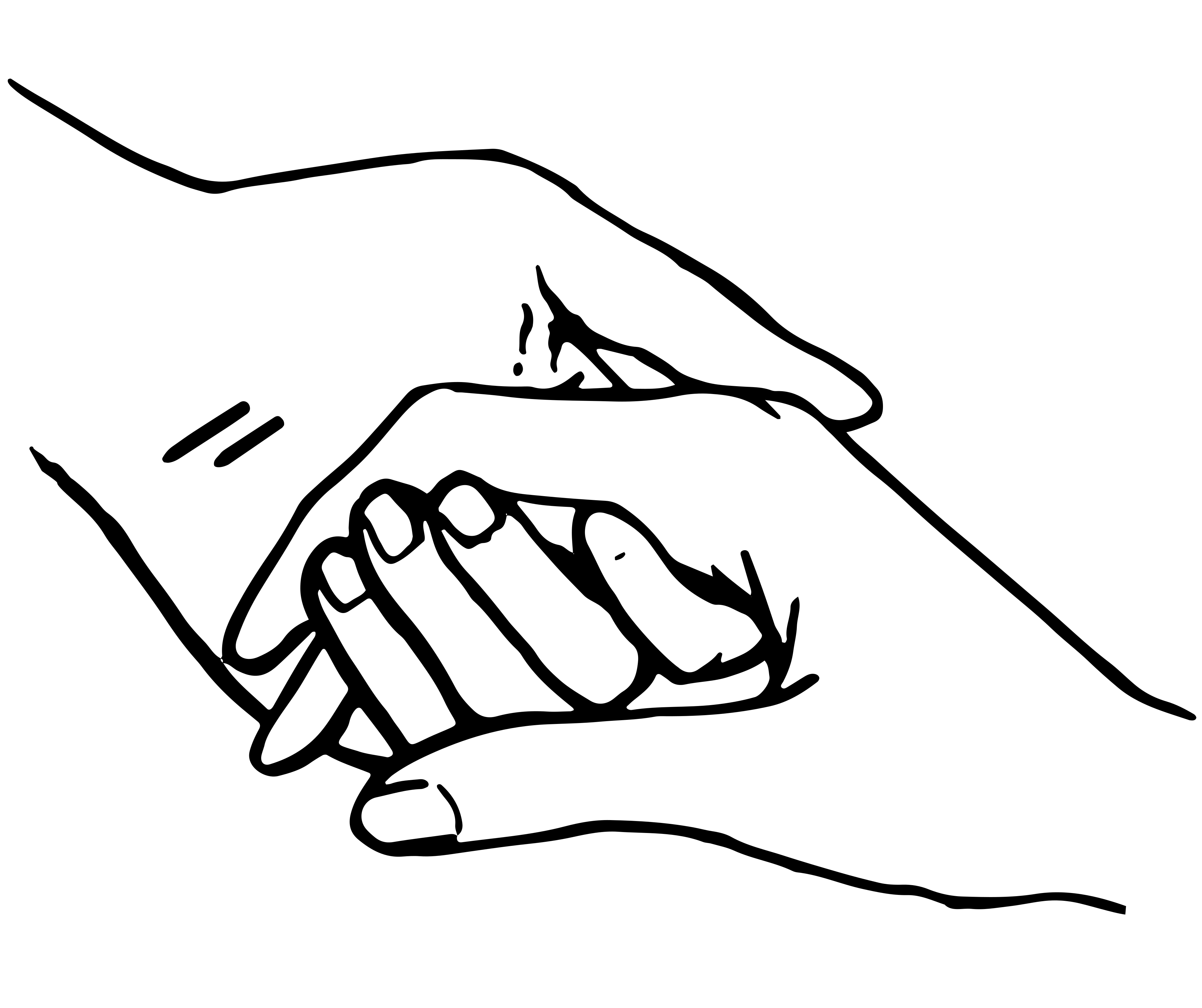
Successful change rarely happens alone. It requires people who have already taken a few steps forward and can extend a hand to others. This results in two key roles:

  1. Change facilitators, mentors or coaches: They have already moved towards the new, possess knowledge others may lack, and can help reduce uncertainty.
  2. Followers, who are still within the old framework (or standing on the “suspension bridge” mentioned in part 1) but are looking forward with curiosity.

If, as a leader, I can already see the light at the end of the bridge, I can encourage and support those who are hesitant. At the same time, I can seek mentors in areas where I still feel uncertain myself.

Ask yourself: am I already someone who can help others – or do I still need a hand to guide me across the suspension bridge?

The benefits of professional change facilitation

  • Accelerated learning: External coaches or internal mentors with a track record of success help avoid common pitfalls.
  • A neutral perspective: Internal power structures often hinder objective analysis. An outside view can uncover conflicts more quickly.
  • Emotion management: A good coach is a companion, listener and mediator during team tensions.

Giving and receiving is at the heart of successful change management. It is crucial that innovators do not speak a different language from colleagues who are still hesitant — otherwise their message will not reach them. Mentors or coaches do not need to be perfect, only two or three steps ahead, so that others can trust them.

Seeing emotions as signposts (not disruptions)

One central element of this mindset is how we deal with emotions, as discussed in part 1. In the old world of work, the message was often: Emotions have no place at work. Yet emotions are powerful drivers of motivation and innovation. When we feel inspired — not blocked by fear or frustration — we perform better.

Good leadership therefore means allowing emotions, recognising them as valuable feedback and using them constructively. Leaders who embrace this naturally move away from a culture defined solely by numbers, data and facts.

Emotions are our most valuable distinction from machines. They can drive or slow us down — and we can use them consciously.

Instead of avoiding conflict or vague fears, we should face them, speak openly about them and uncover what lies beneath. This clarity makes it possible to shape change from within rather than imposing it as an unwelcome reorganisation.

Intuition is more important than reason

Intuition is more important than reason

In many organisations, decisions are still made primarily through rational analysis, supported by metrics, tools and committee resolutions. This is useful — but only part of the truth. The rational mind can draw only on past experience, while intuition acts as a deeper, more far‑reaching compass.

Top executives know this well: highly complex questions cannot be solved purely through rational discussion. Market dynamics, customer needs and technological trends shift constantly. The ability to sense intuitively what direction feels right is becoming increasingly important.

Intuition in management

  • Added value: Intuition does not replace sound analysis — it complements it.
  • Listening inward: Whether experienced as a ‘gut feeling’ or an inner voice, intuition is closely linked to subconscious knowledge.
  • A proven approach: Many top executives rely on a mix of data analysis (logic) and instinctive decision‑making (intuition).
  • Encouraged through space: Constant time pressure blocks intuitive insight and limits creativity.

A look ahead – and a call to action

At the heart of change management is a vision: organisations where people can contribute their whole selves without being chronically overloaded. Work in which performance is combined with freedom, meaning and empathy.

Change cannot happen everywhere at once, nor always smoothly. Tension is a natural part of the process when an old world gives way to a new one. The challenge is to stay in dialogue, remain curious and allow ourselves to be guided by inspiring role models.

Change management in small steps

  •  Take the first steps with courage.
  • Clarify with your team what freedom and responsibility mean in concrete terms.
  • Continuously practise the elements of change and open dialogue.
  • Lead by example: listen, ask questions, tolerate uncertainty and highlight opportunities.
  • Invite both young talents and experienced employees who want to shape the transition.

Ahead of us does not lie a perfect world, but a new world — one in which we no longer place people behind performance, but bring people and performance into healthy balance.

Those who have already experienced this shift say that it creates synergy, innovation and a new kind of success that was barely imaginable in the old world.

A paradigm shift does not happen overnight. But every leader who starts the journey — and brings others along — helps create the conditions for this new world. It may not be the easiest path, but it is certainly a worthwhile one.

About the authors

  • Dr. Sabine Reithofer-Reinhardt is a Senior Consultant at next level consulting Salzburg and a lecturer at the University of Salzburg. Her main focus lies in project and change management. She is also the author of the PMA‑recommended specialist book 'Diamond Thoughts' and regularly produces podcasts under the title 'Diamond Ladies Talk'.
  • Thomas Weidinger is a communications professional, former editor‑in‑chief and content creator for text, image and audio.

You might also be interested in the following training courses

Inhouse Training
Compact Course in Change Management
Price on request
Vienna
German and English
Inhouse Training
Managing Conflict in Projects
Price on request
Vienna
German and English
The Art of Change: Shift Happens
€ 200,-
excl. VAT
Vienna
German
Inhouse Training
Change Management im digitalen Wandel
Price on request
German
Inhouse Training
Emotionen im Management
Price on request
German
Stress-, Zeit- und Selbstmanagement in Projekten
€ 1.290,-
excl. VAT
Vienna
German